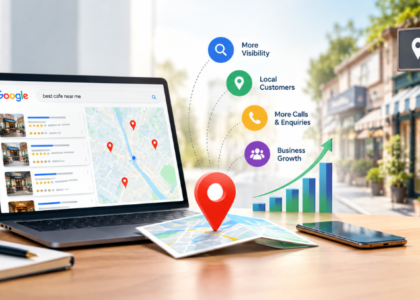
For a small business, being visible online can directly affect how easily potential customers discover your products or services. While paid advertising can generate immediate visibility, organic search can help businesses build a sustainable source of traffic over time.
SEO for Small Businesses is about making your website, content, business information, and online presence easier for search engines and customers to understand. The goal is not simply to rank for a few keywords. It is to build a useful digital presence that answers customer questions, demonstrates expertise, and makes it easy for people to take the next step.
In 2026, this also means preparing content for changing search experiences, including AI-powered search features, conversational queries, mobile search, and local discovery.
Why SEO Matters for Small Businesses
Small businesses often compete with larger brands that have bigger marketing budgets and stronger domain authority. SEO can help level the playing field by allowing a business to target specific topics, services, locations, and customer needs.
A strong SEO strategy can help you:
- Increase organic search visibility
- Attract people actively searching for your products or services
- Generate relevant website traffic
- Build long-term brand visibility
- Support local search discovery
- Improve website usability and navigation
- Build topical authority
- Create useful content for customers
- Generate qualified leads without relying entirely on paid advertising
For local businesses, search visibility is especially important. Recent consumer research from BrightLocal found that 84% of consumers had searched online for a local business during the previous three months, while many consumers used more than one channel during their search journey.
How SEO for Small Businesses Works
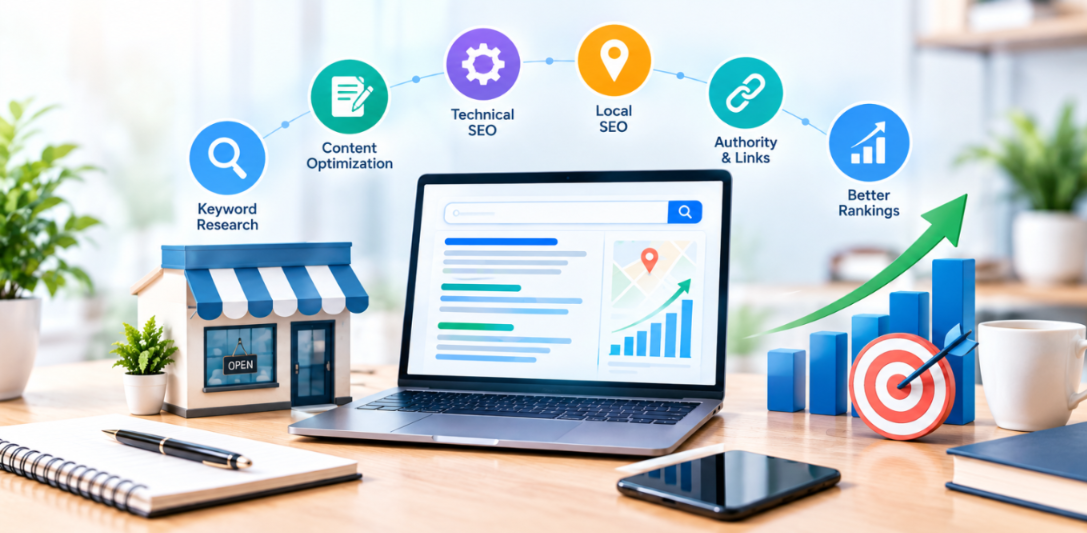
SEO is not one single activity. It is a combination of technical improvements, useful content, keyword targeting, local optimization, authority building, and ongoing measurement.
A practical SEO framework can be divided into five areas:
1. Keyword Research
Start by understanding what your customers actually search for.
Instead of targeting only broad keywords such as “digital marketing,” a small business can target more specific phrases such as:
- SEO for Small Businesses
- SEO services for small businesses
- local SEO services
- SEO agency for small businesses
- Google Business Profile optimization
- SEO services in Siwan
- digital marketing agency in Siwan
Longer and more specific search queries can help you create content around clear user needs.
2. On-Page SEO
Your target keyword should appear naturally in important areas of the page, including:
- SEO title
- Main heading
- Introduction
- Relevant subheadings
- Body content
- Image alt text where appropriate
- Meta description
- URL, when suitable
However, repeating a keyword unnecessarily can make content difficult to read. Search engines increasingly focus on understanding the overall topic and usefulness of a page rather than rewarding mechanical repetition.
3. Technical SEO
Technical SEO helps search engines crawl, understand, and index your website.
Small businesses should pay attention to:
- Mobile responsiveness
- Page speed
- HTTPS
- Clean URL structure
- Internal linking
- XML sitemap
- Canonical URLs
- Indexability
- Broken links
- Core Web Vitals
- Structured data where appropriate
Google Search Central provides documentation covering search appearance and structured data that can help websites communicate important information more clearly to search engines.
4. Content SEO
Useful content gives your website opportunities to appear for questions customers ask before making a decision.
Instead of publishing generic articles just to increase word count, create content around genuine customer problems.
For example, a local marketing agency could publish:
- How Local SEO Helps Small Businesses
- How to Optimize a Google Business Profile
- SEO Mistakes Small Businesses Should Avoid
- How to Choose an SEO Agency
- Local SEO Checklist for New Businesses
- How Reviews Affect Local Business Visibility
This type of topical coverage can help establish a stronger relationship between your website, services, and target audience.
5. Authority and Links
Links from relevant websites can help search engines discover content and understand relationships between websites.
For small businesses, the focus should be on earning relevant, trustworthy mentions rather than collecting as many backlinks as possible.
Useful sources may include:
- Industry publications
- Local business websites
- Relevant blogs
- Business directories
- Partner websites
- Professional organizations
- Local news websites
- Resource pages
A strong SEO strategy combines keyword research, content, technical SEO, local search, and website performance. Zenith Forge offers further resources on SEO and digital marketing for businesses.
SEO Priority Graph for Small Businesses
A useful way to prioritize your SEO work is to think about the major areas as a connected system:
SEO Growth Priorities
Technical SEO
████████████████░░ 80%
Useful Content
█████████████████░ 85%
Local SEO
██████████████████ 90%
On-Page SEO
████████████████░░ 80%
Relevant Backlinks
███████████████░░░ 75%
Measurement & Updates
██████████████░░░░ 70%
This is a strategic priority framework, not a ranking-factor score.
The important point is that SEO works best as a system. Improving one area while completely ignoring the others can limit overall performance.
Local SEO: A Major Opportunity for Small Businesses
For businesses serving a specific city, region, or service area, local SEO deserves special attention.
Google states that local search results are primarily based on relevance, distance, and prominence. Complete and accurate Business Profile information helps Google understand how a business relates to relevant searches.
This makes local optimization especially valuable for businesses such as:
- Restaurants
- Hotels
- Clinics
- Salons
- Real estate businesses
- Educational institutes
- Local service providers
- Digital marketing agencies
- Retail stores
- Home-service businesses
If you want to understand the broader role of local search, read this detailed guide on [Why Local SEO Is Important] for additional context.
Google Business Profile and SEO
A properly managed Google Business Profile can support local discovery on Google Search and Maps.
Google explains that eligible businesses can use a Business Profile to manage information such as business hours, website, phone number, location, photos, and customer interactions.
For local businesses, make sure your profile contains:
- Correct business name
- Accurate primary category
- Current business hours
- Correct phone number
- Website URL
- Accurate address or service area
- Relevant photos
- Useful business description
- Genuine customer reviews
- Responses to customer reviews
Google also recommends keeping business information complete and accurate and responding to reviews.
Important: Do not treat your Business Profile as a place to stuff keywords. Google specifically advises businesses not to use categories simply as keywords.
For service-area businesses, Google allows businesses to specify the cities, postal codes, or other areas they serve rather than using an arbitrary radius.
High-authority GBP resource: Google Business Profile Help — Tips to improve your local ranking on Google.
Build Location-Specific Landing Pages
If your business genuinely serves multiple locations, location-specific landing pages can help communicate those services clearly.
For example, instead of creating one generic page titled “SEO Services,” an agency may have relevant pages such as:
- SEO Services in Siwan
- SEO Services in Patna
- Local SEO Services in Bihar
Each page should contain genuinely useful location-specific information rather than replacing the city name repeatedly.
A strong location page can include:
- Services offered
- Areas served
- Local customer problems
- Relevant examples or case studies
- FAQs
- Business information
- Clear contact options
- Supporting internal links
Create Content Around Search Intent
One of the most important parts of SEO for Small Businesses is understanding why someone is searching.
Search intent can generally be grouped into four categories:
Informational Intent
The user wants to learn something.
Example:
“How does local SEO work?”
Create:
- Guides
- Tutorials
- Checklists
- Explainers
- FAQs
Navigational Intent
The user is looking for a specific website or brand.
Example:
“Digiloom Media SEO services”
Make your brand and website information easy to discover.
Commercial Investigation
The user is comparing solutions.
Example:
“best SEO agency for small businesses”
Useful content includes:
- Comparison guides
- Service explainers
- Case studies
- Pricing information
- Benefits and limitations
Transactional Intent
The user is ready to take action.
Example:
“SEO services for small business”
These searches can be supported by:
- Service pages
- Contact pages
- Consultation pages
- Lead forms
- Clear CTAs
Use Internal Links Strategically
Internal linking helps users discover related content and helps search engines understand how pages on your website are connected.
For example, a small-business SEO article can link naturally to:
- Local SEO service pages
- SEO guides
- Case studies
- Contact pages
- Google Business Profile resources
- Related blog posts
A contextual internal link from this article to your existing Why Local SEO Is Important article can also help connect informational content with your broader local SEO topic cluster.
Earn Relevant Backlinks
Backlinks remain an important part of website authority, but quality and relevance should guide your link-building strategy.
For small businesses, practical backlink opportunities include:
- Local publications
- Industry blogs
- Business associations
- Partner businesses
- Relevant resource pages
- Expert contributions
- Digital PR
- Local directories
Avoid building links purely for volume. A relevant contextual mention from a genuine industry publication can be more useful than many unrelated links.
Google has also continued to emphasize policies against practices designed primarily to exploit the ranking value of established websites through third-party content.
That makes relevance, originality, and genuine editorial value particularly important when planning guest posts or link exchanges.
Optimize Content for AI and Conversational Search
Search behavior is becoming more conversational.
People may ask:
- “What is the best SEO strategy for a small local business?”
- “How can a small business rank on Google?”
- “How do I improve my Google Maps visibility?”
- “What should a small business do before hiring an SEO agency?”
To make your content easier to understand across traditional and AI-assisted search experiences:
- Answer questions directly
- Use descriptive headings
- Keep important answers concise
- Add useful examples
- Use structured lists
- Support claims with reliable sources
- Demonstrate first-hand expertise where possible
- Keep business information consistent
- Cover related questions within the same topic
Google’s current Search documentation includes dedicated guidance around AI features and search appearance, showing that search experiences continue to evolve.
Measure Your SEO Performance
SEO should be measured using meaningful business and search metrics rather than rankings alone.
Track:
- Organic clicks
- Organic impressions
- Search queries
- Average position
- Organic conversions
- Leads
- Phone calls
- Form submissions
- Local visibility
- Google Business Profile interactions
Google Business Profile performance data can show searches, views, and customer actions, helping businesses understand how people discover and interact with their profile.
Simple SEO Measurement Funnel
Search Visibility
↓
Website Visit
↓
Relevant Page Engagement
↓
Lead / Call / Enquiry
↓
Customer
The ultimate objective is not simply to increase traffic. It is to attract the right traffic and turn visibility into meaningful business outcomes.
A Practical SEO Checklist for Small Businesses
Before publishing or optimizing a page, check:
- One clear primary search intent
- Focus keyword used naturally
- Helpful title and H1
- Clear introduction
- Descriptive subheadings
- Relevant internal links
- Useful external sources
- Mobile-friendly layout
- Optimized images
- Fast page experience
- Clear CTA
- Relevant FAQs
- Accurate business information
- Google Business Profile optimized
- Content reviewed for originality and usefulness
Is SEO worth it for a small business?
Yes. SEO can help small businesses build organic visibility and reach people actively searching for relevant products or services.
How long does SEO take for a small business?
Results vary by competition, website condition, content quality, authority, and location. SEO should generally be treated as a long-term process rather than an instant traffic tactic.
Does a small business need a Google Business Profile?
Eligible storefront and service-area businesses can benefit from a Google Business Profile because it helps them appear on Google Search and Maps.
What is the most important part of small business SEO?
There is no single universal tactic. Strong results usually come from combining relevant content, technical SEO, on-page optimization, local visibility, authority, and measurement.
Can SEO help a local business get more customers?
Yes. SEO can improve visibility for relevant searches, while local SEO can help businesses reach customers searching for nearby products and services.
How can small businesses improve Google Maps visibility?
Start with an eligible, verified, complete and accurate Business Profile, then maintain relevant business information, reviews, photos, and a strong local website presence. Google identifies relevance, distance, and prominence as key local ranking factors.
Final Thoughts
SEO for Small Businesses is not about trying to manipulate search engines or publishing hundreds of low-value pages. It is about building a website and online presence that clearly communicates what your business offers, who it serves, where it operates, and why customers should trust it.
Start with the fundamentals: understand search intent, create genuinely useful content, improve technical SEO, optimize your local presence, build relevant authority, and measure the actions that matter to your business.
For businesses competing in local markets, combining organic SEO with Google Business Profile optimization and strong location-focused content can create a more complete search strategy.
For further local SEO insights and related resources, explore Digiloom Media at the end of your article as a relevant industry resource.